

RCL-CORE
Core Control Daemon
The real-time executive running on each robot. Translate signed control intents from the network into actuator commands with sub-15ms deterministic loop times.
Domain Sale Notice :: This site exists to market the robotcontrollayer.com domain name for sale. It is not a functioning product, service, or active project; all content, diagrams, and metrics are illustrative only. DIMO is a real, independent crypto network — this site is not affiliated with, endorsed by, or connected to DIMO or its application.
Sense → Sign → Settle → Reason → Command → Maintain.

Robot Control Layer is a robot control software and middleware architecture for robotic systems. It is a command, monitoring and predictive-maintenance layer for autonomous fleets, using the DIMO network as its trust and settlement rail. Explore the protocol design, system architecture and technical whitepaper below.
Robot Control Layer is the operating system for autonomous fleets — a settlement, sensing and control fabric that turns thousands of disconnected machines into a single, accountable swarm. DIMO provides the trust layer; we provide the control plane.

Every actuator, sensor and power cell streamed through a unified edge relay. Anomalies surface before they become downtime.
On-chain maintenance logs and ML failure models schedule service automatically. Every repair is a verifiable DIMO transaction.
Role-based control rights minted as programmable permissions. No single point of failure. No single point of capture.
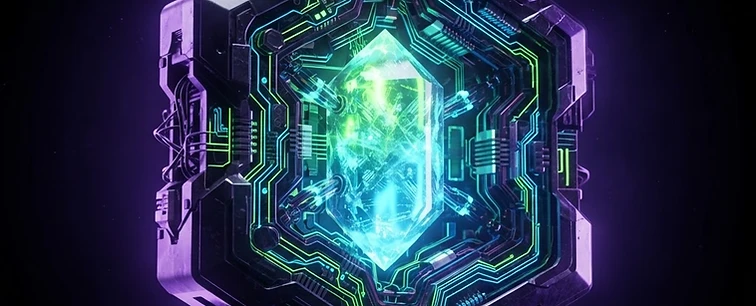
The real-time executive running on each robot. Translate signed control intents from the network into actuator commands with sub-15ms deterministic loop times.
Every telemetry batch, maintenance claim and control transfer is settled as a verifiable DIMO transaction. Provable state, no off-chain gossip.
// settle a control transfer on the DIMO rail
tx = dimo.transfer({
  from: operator.key,
  to:   fleet.owner,
  data: abi.encode(controlIntent, signature),
  stake: 24.6 DIMO
});
await tx.confirm(2); // deterministic finalitySelf-healing relay nodes collapse latency to the edge. Local consensus keeps fleets operational even when cloud links degrade.
Failure models trained on fleet-wide wear signatures schedule service before breakdowns. Every job logged immutably to the DIMO ledger.
Control rights minted as programmable permissions. Operators, owners and auditors hold cryptographically scoped authority — revocable in a single tx.
← drift horizontally →
Multi-modal sensor fusion streams raw state into the edge relay at 1000Hz.
Each telemetry frame is cryptographically signed by the robot's hardware key.
Frames batch into DIMO transactions — provable, ordered, immutable state.
Predictive models and policy engines evaluate fleet state in real time.
Signed control intents return to actuators with sub-15ms deterministic latency.
Wear signatures trigger autonomous maintenance jobs, logged on-chain.
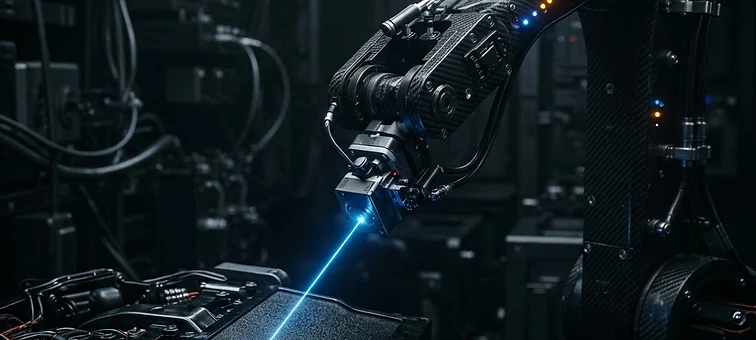
DIMO is the decentralized hardware network for connected devices. Robot Control Layer is its control plane — turning DIMO's verifiable device identity into programmable robot authority.
The two capability cores of Robot Control Layer, in detail: an autonomous predictive-maintenance loop that schedules its own service, and a DIMO-powered monitoring rail where every telemetry point is cryptographically tied to the machine that produced it.
Robot Control Layer collapses the maintenance loop into a single automated pipeline. Wear signatures stream continuously, a fleet-wide model forecasts failure, the scheduler mints its own service jobs, and every outcome settles immutably on the DIMO ledger — then trains the next model. The result is a self-healing fleet whose downtime curve bends toward zero.
Vibration, torque, thermal drift and current-draw signatures stream from every actuator at 200Hz. The Edge Relay Mesh fuses sensor channels per unit and forwards normalized vectors to the fleet model.
A fleet-wide gradient-boosted model scores remaining useful life (RUL) per component every 60s. Confidence intervals feed a Bayesian scheduler that ranks imminent failure probability across the swarm.
When RUL confidence exceeds threshold, the scheduler mints a maintenance job — assigns the nearest qualified service agent, reserves parts, and locks a maintenance window — without a human in the loop.
Completion is attested by the service agent's signed telemetry. The job settles as a DIMO invoice payable in $DIMO. The full record — diagnosis, parts, labor, RUL delta — is immutably logged to the ledger.
Outcome telemetry (did the predicted failure occur? was service effective?) feeds back into the commons. Operators earn $DIMO for contributing anonymized wear data, continuously sharpening the fleet model.
Fleet operators earn $DIMO for contributing anonymized wear data to the commons — turning maintenance telemetry into a revenue stream and continuously retraining the failure model on real-world outcomes.
A category-defining control plane for the autonomous-fleet economy — sized, proven and unit-economic.
Global autonomous-fleet control & monitoring
Warehouse + last-mile robotics, US & EU
DIMO-native fleet operators, 5-yr capture
A phased build of the Robot Control Layer — technical milestones, the DIMO integration arc, and the growth path that de-risks the acquisition for the right builder.
The protocol is built to be acquired. Phase 04 hands the full stack — IP, mainnet control plane, and DIMO integration — to a single strategic builder.
We are seeking a single acquirer — a robotics, mobility or Web3 infrastructure company — to develop and scale Robot Control Layer into the standard for autonomous fleet control. Submit your interest to open a direct dialogue with the founders.
